
In this article
Leaking when you cough, hesitating before a workout or struggling to find the right muscles can affect everyday life. Pelvic floor health is therefore a question of function, control and being able to do the things you want to do. [2, 6]
This guide explains what a pelvic floor chair does, how it differs from active exercises and which questions matter before a visit. For clinic owners, there is also a practical section on how the service can work in a business.
What is a pelvic floor chair?
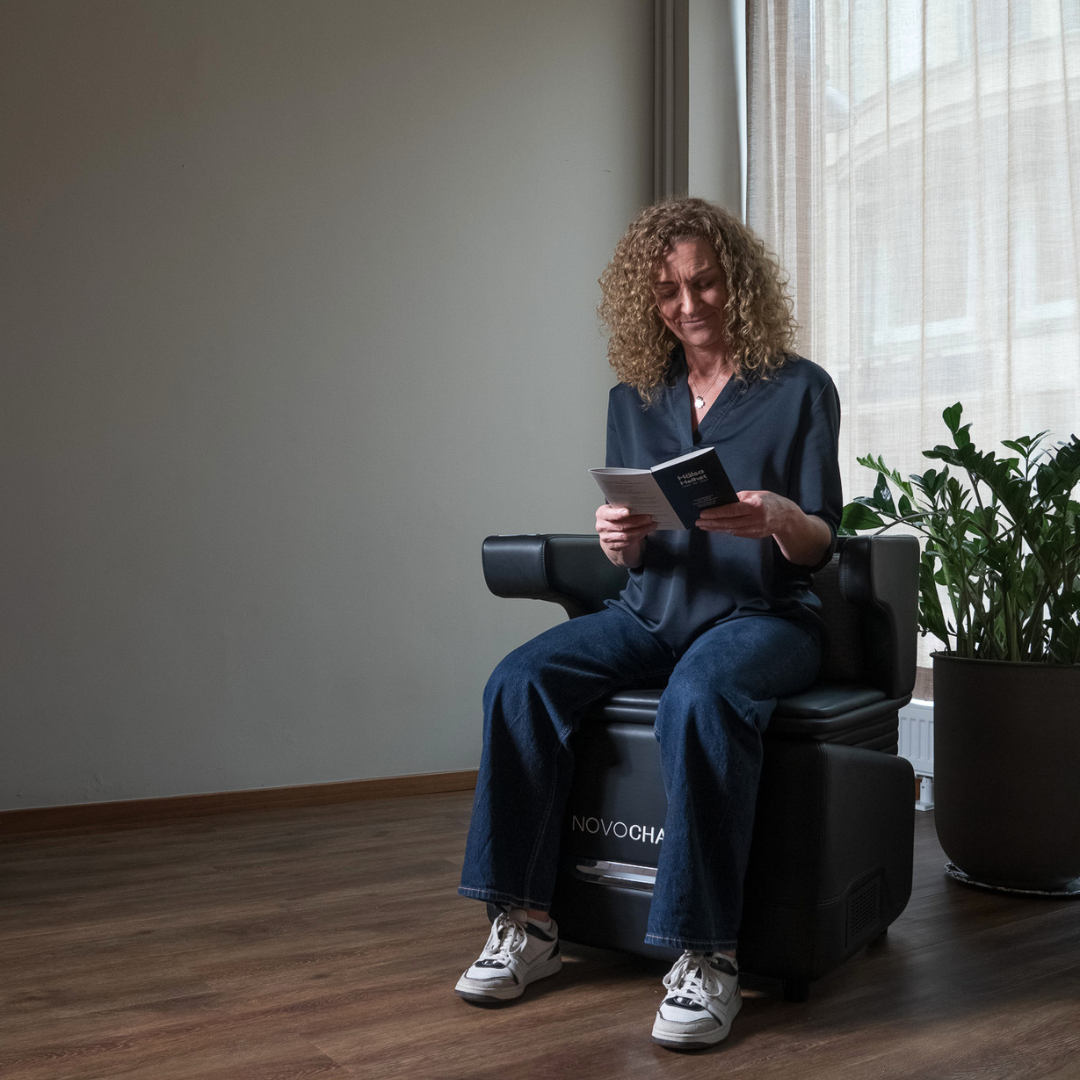
A pelvic floor chair is a treatment chair that uses electromagnetic stimulation to produce pelvic floor muscle contractions. The person sits in the chair while a programme controls the stimulation. With NovoChair, the session takes place fully clothed. [1]
The pelvic floor needs to be able to contract and relax. The ability to control the muscles is therefore as relevant to discuss as strength itself. Where pain is present, the need may instead be to learn to relax. [2]
How does it differ from active pelvic floor exercises?
In active pelvic floor muscle training, you work on finding, contracting and relaxing the muscles yourself. In an electromagnetic chair, contractions are produced through stimulation during the session. The methods work differently. [1, 2]
| Question | Active pelvic floor muscle training | Electromagnetic chair |
|---|---|---|
| What does the person do? | Performs and coordinates voluntary contractions and relaxation. | Sits while stimulation activates the muscles. |
| How is the approach adapted? | Through exercises, technique and progression. | Through programme, intensity and planned follow-up. |
NICE recommends supervised pelvic floor muscle training for at least three months as first-line treatment for women with stress or mixed urinary incontinence. This recommendation concerns active training and should not be interpreted as a recommendation of a treatment chair. [3]
The number of contractions a chair produces does not by itself tell us how large the effect will be. A session cannot therefore be equated with a fixed number of correctly performed voluntary contractions or several months of training.
Which needs may be relevant?
Questions about the pelvic floor often arise with urine leakage or after pregnancy and childbirth. But the same symptoms can have different causes. Stress incontinence involves leakage during activities such as coughing or physical exertion; urgency incontinence involves a sudden strong need to urinate. This affects which help is appropriate. [6]
People with symptoms should have them assessed by healthcare. A pelvic health physiotherapist, continence specialist or other relevant healthcare professional can help with assessment and an individual plan. Pain or difficulty relaxing should be addressed before more muscle activation is planned. [2, 6]
Before a NovoChair session, staff review the health questionnaire and the chair's contraindications. Pregnancy, implants and previous surgery are examples of matters that need to be raised. This is not a complete safety checklist; assessment should follow the chair's current instructions. [1]
What does the research say about magnetic stimulation?
Some studies report improvements in urine leakage and symptoms. A 2026 research review brought together 15 systematic reviews and meta-analyses. It reported favourable outcomes compared with sham treatment, but also differences in treatment protocols, variable study quality and limited evidence on effects beyond six months. [4]
The findings are not uniform. A randomised pilot study involving 40 participants compared magnetic stimulation plus pelvic floor muscle training with sham stimulation plus the same training. The researchers found no statistically significant difference in change between the groups for the measures investigated. [5]
The research concerns specific participant groups, devices and protocols. It should not be presented as if NovoChair itself had been tested in these studies. For a clinic, it is relevant to ask which evidence concerns the method and which documentation concerns the particular product.
What happens during a NovoChair session?
- Review before starting. Staff and customer discuss circumstances, safety questions and the purpose of the visit.
- Positioning and settings. The customer sits fully clothed. Programme and intensity are selected on the touchscreen with an introduction from staff.
- The session itself. A typical visit includes approximately 30 minutes of stimulation. The sensation may include tingling and rhythmic contractions; intensity is adapted and staff should be able to help if discomfort occurs.
- Follow-up. Afterwards, the experience is reviewed and any further use is planned for follow-up. Introduction and follow-up take additional time beyond the programme itself.
The number of sessions and intervals need to be adapted to the individual and the chosen approach. A fixed number of visits does not guarantee a particular result. [1]
Lyfe Nordic's perspective
A good treatment plan starts with the right assessment and is followed up against what the customer wants to be able to do in everyday life.
For clinics: plan the whole visit
A clear service makes it easier for customers to understand what is offered and for staff to work consistently. Start with the target group, your team's competence and how you handle people who need healthcare support.
- Make space for a private conversation. Customers should be able to discuss sensitive symptoms without having to do so at reception.
- Plan the whole booking slot. Allow for introduction, settings, customer changeover and follow-up in the appointment schedule.
- Make responsibilities clear. Decide who introduces the customer, who is available during the session and who follows up.
- Track something that matters to the customer. Agree what to evaluate and when, rather than simply counting completed visits.
A real example: HälsaHelhet
At HälsaHelhet in Kristianstad, NovoChair is part of the salon's offering alongside other treatments. CEO Maja Berg describes its accessibility:
“NovoChair makes it easy to offer a treatment that customers actually need”
Translated from Swedish. This experience describes how a business has chosen to work with the service. Read the full HälsaHelhet customer story for their perspective.
Frequently asked questions about pelvic floor chair training
Do I need to undress?
A NovoChair session takes place fully clothed. Follow staff instructions about clothing and items that need to be removed before starting. [1]
Can a chair replace all active pelvic floor exercises?
Follow the individual treatment plan. Active training has an established role in urinary incontinence and also trains the ability to use the muscles consciously. Discuss with your healthcare professional how any stimulation fits alongside your exercises. [2, 3]
Is the treatment suitable for everyone with urine leakage?
The cause of leakage, health and the chair's contraindications need to be assessed first. A chair is not a general solution for every type of urinary incontinence. [1, 6]
Are there programmes for both women and men?
NovoChair has programmes for women and men. A programme name does not determine whether treatment is appropriate for an individual or diagnosis. [1]
Would you like to explore NovoChair for your business?
The NovoChair product page has more information about functions, specifications and getting started. To discuss premises, customer flow and training, you can book a consultation with Lyfe Nordic or request a quote.
For more background, read 5 things you may not know about pelvic floor training.